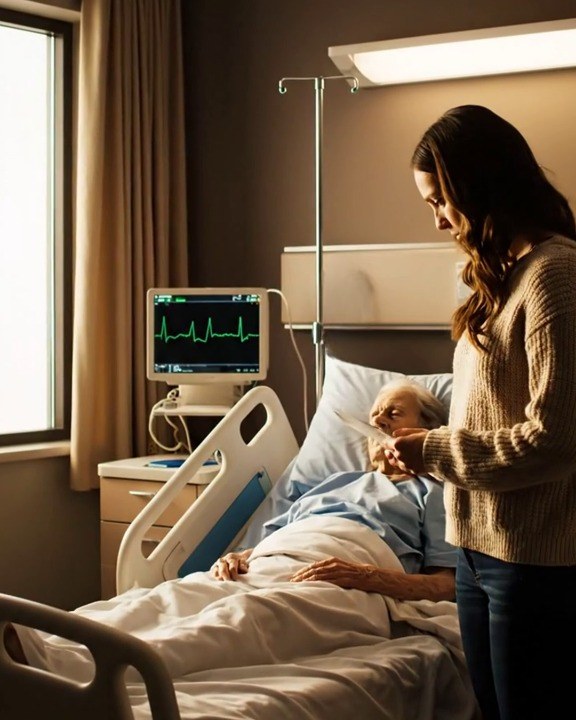
Even the cottage felt like it had an opinion. Each time I refused them, the old floorboards creaked in a way that felt like approval.
As spring turned into summer, I began to restore the place, guided by entries in Holly’s journals.
Always wanted this place filled with conversation and laughter, she had written once. Ben and I dreamed of hosting gatherings, for friends, for the community. Then life got in the way, and somehow it never happened.
I hired local contractors to fix the sagging porch and update the plumbing. I painted the walls in warm, inviting colors and replaced worn carpet with polished hardwood. Then I added one final touch, a hand-carved wooden sign over the front door.
Holly’s Haven.
With Mrs. Keller’s help, I used part of Holly’s investments to establish a nonprofit foundation. We opened on what would have been Holly’s seventy-third birthday, turning the cottage into a place for grief support groups, elder companionship programs, and weekly community dinners.
“Holly would’ve loved this,” Diane said, eyes wet as she walked through the renovated rooms.
Diane became a regular visitor during the renovations, telling me stories that brought Holly to life in a way I’d never known.
“She was always the first to organize a meal train when someone got sick,” Eleanor said, straightening a framed photo of Holly in the entryway. “And those cooking classes she taught at church, she made everyone feel like family.”
The irony wasn’t lost on me. Holly had built family out of strangers while her own children walked away. But through the foundation, the town began to talk about her differently, not as the lonely woman who died alone, but as someone whose legacy was pulling people together.
Six months after Holly’s death, Travis tried his most deliberate move yet. He asked me to lunch at our old favorite restaurant, an intimate Italian place where we’d celebrated birthdays and anniversaries. He arrived early and sat at our usual table by the window. When I sat down, he reached for my hands.
“I’ve been thinking,” he said, voice low and earnest. “Soul-searching. I wasn’t the husband you deserved. I wasn’t the son my mother needed.”
I pulled my hands away, watching him closely.
“I want a fresh start, Court,” he said. “We can renew our vows. We can rebuild.”
He pulled out a small velvet box and set it between us.
“I found Mom’s engagement ring,” he said. “She would’ve wanted you to have it.”
The lie nearly stole my breath. Holly’s engagement ring was locked in my jewelry box at the cottage. It had been returned to me with her effects.
“That’s not her ring,” I said quietly.
His composure slipped for a fraction of a second, then he recovered. “It’s similar. That’s not the point. Meet me at Riverside Park this weekend. Let’s talk about us. About our future.”
I agreed, not because I believed him, but because I wanted to see what he would try next.
On Saturday, the park was blazing with autumn color. Travis waited by the stone bridge where he’d proposed three years earlier, his love of dramatic symmetry on full display. He even brought champagne and two glasses.
“You came,” he said, surprise and relief flashing across his face.
“I did,” I said. I reached into my bag and pulled out a manila envelope. “And I brought something for you, too.”
His face brightened as he grabbed it, clearly expecting a sign of surrender. Instead, he found separation papers, already signed.
“What is this?” he demanded, even though the answer was obvious.
“It’s exactly what it looks like,” I said. “You made your choices a long time ago, Travis. Now I’m making mine.”
“You can’t do this,” he sputtered. “After everything I’ve done to fix things…”
“You haven’t fixed anything,” I said. “You’ve just tried to get your hands on Holly’s money. That’s not the same thing.”
He tore the papers in half, a childish move that changed nothing. My attorney already had the originals.
“This isn’t over,” he snapped, storming away.
But it was.
Two days later, an email from Stella arrived. Her tone was completely different, no more rage, just a careful apology and a desperate plea.
I’ve hit rock bottom, she wrote. I know I don’t deserve your help, but I’m desperate. Even a small loan would make a difference.
I stared at the message for a long time, then thought of Holly’s final instruction. I scanned that letter and attached it to my reply, nothing else.
Forgive no one. Let them beg. Let them kneel. And when they do, smile, turn, and walk away.
Then I blocked her email.
That evening, I walked through Holly’s Haven after everyone left. The rooms still carried the day’s echoes: elderly neighbors sharing stories over tea, a young widow finding comfort in a support group, kids laughing during an afterschool program. For the first time since Holly died, peace settled over me in a way that felt real.
I wasn’t just someone’s wife anymore. I wasn’t just someone’s daughter-in-law. I was my own person, carrying forward the legacy of a woman who had been dismissed and hurt, and who refused to vanish quietly.
I ran my fingers along the spines of Holly’s journals, now displayed on a special shelf in the community room.
“I get it now,” I whispered into the empty space. “This is what you wanted.”
A year moved like pages turning, sometimes slow, sometimes fast, but always adding to a story still unfolding.
Holly’s Haven grew beyond anything I had imagined. What started as a simple community space became a daily heartbeat of activity: Monday art classes for seniors, Tuesday grief circles, Wednesday dinners where strangers became friends over homemade lasagna and apple pie. The cottage that once stood empty and forgotten now felt alive.
On the anniversary of Holly’s passing, we unveiled a mural in the entry hall. A local artist worked from photos I’d found in Holly’s albums, images of Holly and Ben in their younger years beneath the sprawling oak tree behind the cottage. In the painting, Holly laughed with her head thrown back while Ben looked at her with open adoration.
“It’s them,” Eleanor said during the unveiling, wiping her eyes. “Exactly them, before everything changed.”
The “everything” hung unspoken: Ben’s death, the abandonment, the isolation. But the mural wasn’t an ending. It felt like a continuation.
“Holly would’ve hated all this attention,” Diane said with a watery laugh, gesturing at the crowd. “But secretly, she would’ve loved it too.”
I nodded, throat tight. She would’ve acted embarrassed while storing every detail to write about later.
That night, when everyone was gone, I sat alone in the room that had once been Holly’s bedroom and now served as my office. The local paper had covered the mural, and I traced my finger over the headline.
Holly’s Haven marks one year of community service.
The article mentioned our upcoming senior health fair and quoted people who said the center changed their lives. My phone buzzed with a text from Mrs. Keller.
Holly would be proud. Not only of the center, but of you.
The following week, I was invited to speak at a regional conference about elder care and community support. The organizer had visited during an open house and was impressed by our programs.
For Complete Cooking STEPS Please Head On Over To Next Page Or Open button (>) and don’t forget to SHARE with your Facebook friends.